Thinking
Education has always been a reflection of the times, evolving to meet the needs of the changing society it serves. Currently, schools and school systems are pressed to adapt to societal demands at a pace that is yet unseen. Trends are far-reaching, touching every form of education and every aspect of the educational process, including content offered and teaching methods used. There is an overarching trend toward the use of technology, such as artificial intelligence, virtual learning, and the use of technological tools that support (or replace) the need to think things over. Like it or not, these trends are redefining what we think of as teaching and learning. Educators at every level must consider rapid shifts and accommodate them as they reevaluate both curriculum content and delivery.
We must encourage thinking about the foundations of learning. This is the place for reflective thought, brainstorming, and futurecasting. Here, we pose problems to consider and use the PBL Learning Grid to order our thinking.
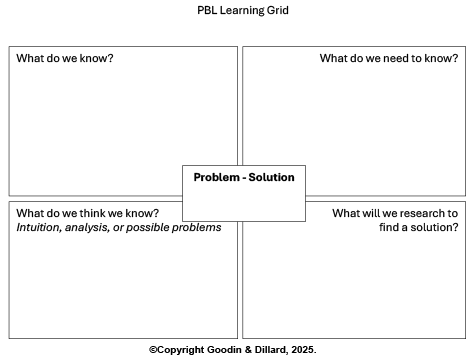
The first questions from the learning grid are:
- What do we know? (Facts with No Interpretation)
- What do we need to know? (Prompted by Question 1 and Also by Our Unconscious Definition of the Problem)
Think
Education has always been a reflection of the times, evolving to meet the needs of the changing society it serves. Currently, schools and school systems are pressed to adapt to societal demands at a pace that is yet unseen. Trends are far-reaching, touching every form of education and every aspect of the educational process, including content offered and teaching methods used. There is an overarching trend toward the use of technology, such as artificial intelligence, virtual learning, and the use of technological tools that support (or replace) the need to think things over. Like it or not, these trends are redefining what we think of as teaching and learning. Educators at every level must consider rapid shifts and accommodate them as they reevaluate both curriculum content and delivery.
We must encourage thinking about the foundations of learning. This is the place for reflective thought, brainstorming, and futurecasting. Here, we pose problems to consider and use the PBL Learning Grid to order our thinking.
The first questions from the learning grid are:
- What do we know? (Facts with No Interpretation)
- What do we need to know? (Prompted by Question 1 and Also by Our Unconscious Definition of the Problem)